
Kundalini: spinal vortex and spiral
Breath paired with circling or arching the torso: Ed's three movement sessions.
Read this first
- Sit or lie down somewhere safe. Never practise standing.
- Never practise while driving, riding, bathing, swimming or near water.
- If you can't hold your breath any longer, breathe in. This is not a contest.
- If you feel dizzy or tingly, stop at any time and return to natural breathing.
- If you are pregnant or have a heart condition or serious health problem, ask a medical professional first. This is not medical advice.
What Ed says
Ed has three sessions that join breath and spinal movement: spinal breathing (arching forward and back like a pump), vortex breathing (turning the spine into a vortex), and helical breathing (the torso circling in three dimensions: inhale left and forward, exhale right and back). In his words, energy goes into the central axis on the in-breath and pressure is squeezed out on the out-breath.
Principles: the force comes from the thoracic spine and abdomen, an imaginary rope pulls the crown upward to keep space in the spine, and the neck just follows. He repeats that safety and smoothness come first, movements stay comfortable, and you slow down or stop if dizzy. Each ends with five minutes of six-in, six-out integration.
If you have back or neck problems or an injury, ask a medical professional first. This is a movement practice; do it in a safe space.
「吸氣左前轉,吐氣右後卷」
Inhale, turn left and forward; exhale, curl right and back.
「吸氣時把能量打進去,吐氣時把壓力擠出來」
On the inhale drive the energy in; on the exhale squeeze the pressure out.
「把脊椎變成一個漩渦,把壓力全部都釋放出來」
Turn the spine into a vortex and let all the pressure out.
Hear him say it

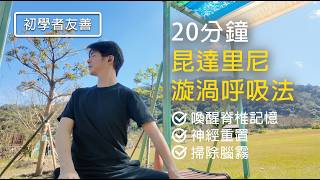

Try it now
- 1Sit in a stable spot with room for the arms and torso.
- 2Start slowly with the video: small, smooth, comfortable movements, with force coming from the thoracic spine and abdomen.
- 3Slow down or stop if dizzy; end with the video's quiet six-in six-out integration.
Ed: "safety and smoothness always come first".
Common experiences and questions
- What is Kundalini?
- In tradition it refers to dormant energy at the base of the spine. Ed's use is practical: breath paired with spinal movement, to experience a sense of waking up.
- Can I do it with back pain?
- Ask a medical professional first. Ed says keep it comfortable; stop if it isn't.
- What if emotions come up?
- He reminds you the space is safe and you can stop at any time; if you're recovering from psychological trauma, think it over.
This is a write-up of Ed's teaching, not medical advice or therapy. If you have health concerns, are pregnant, or have a heart condition or trauma, ask a professional first.